Loading...
Philosophy
Every Business Is Different
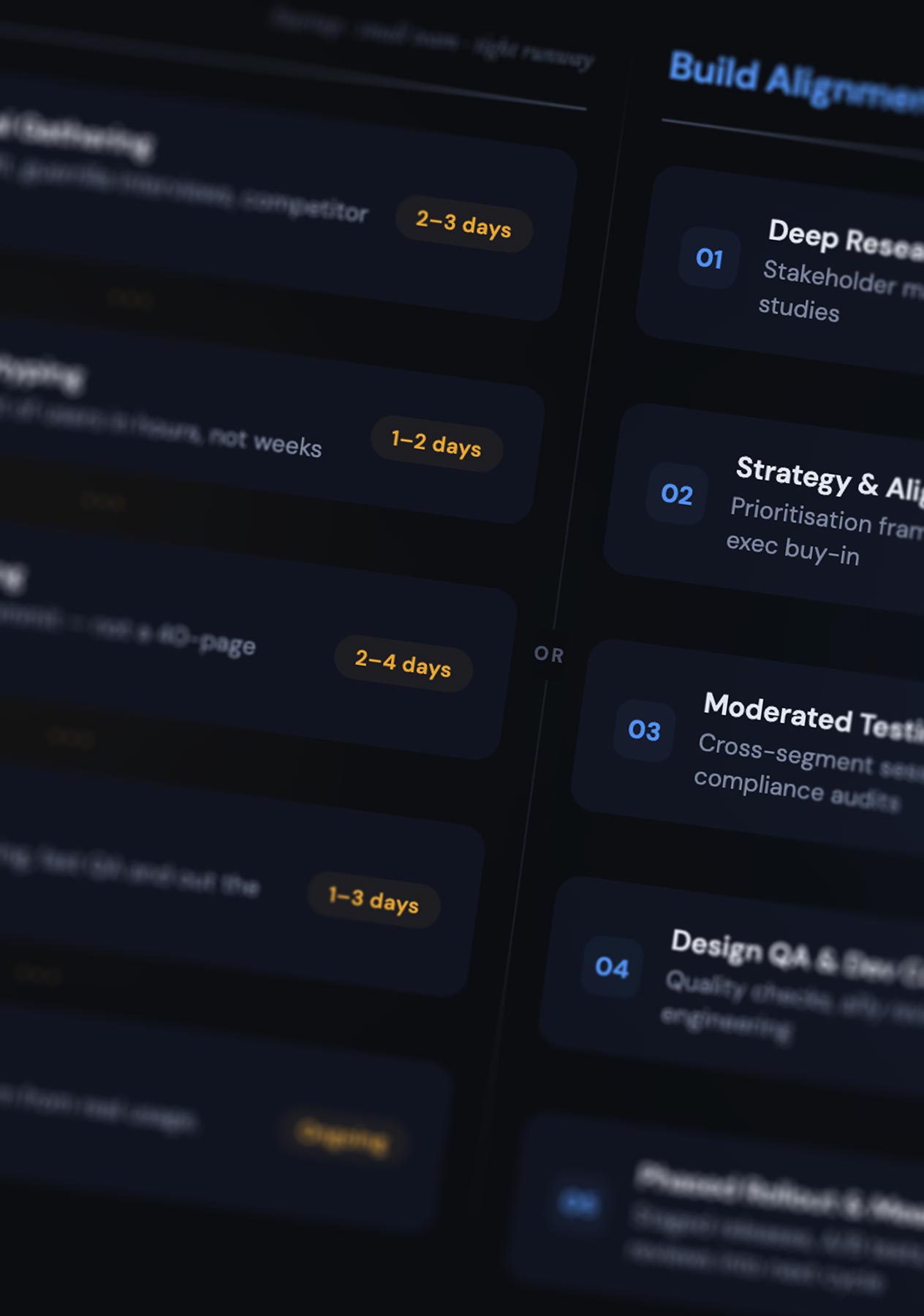
Different budgets, timescales, team sizes, and skillsets to collaborate with. A startup burning through runway needs speed above all else. An enterprise with complex stakeholders needs alignment at every stage. The right process adapts to those realities — not the other way around.
That's why I don't believe in a rigid framework. Sometimes it's AI-first prototyping to get concepts in front of users within hours. Sometimes it's extensive research and stakeholder workshops before touching a design tool.
But some things don't change. Decisions need evidence. Solutions need testing with real users. Speed matters — validation before build means fewer wasted sprints, and AI throughout means faster analysis, faster prototypes, faster decisions. The result: teams that ship at pace and products that land.
The Process
From insight to impact
01
Analyse Data
Customer feedback, sales data, churn surveys, usage analytics.
This is where churn gets explained, stalled roadmaps get unblocked, and engineering time stops being wasted on the wrong things.
02
Align Strategy
Map findings to business goals. Reducing churn? Growing users?
Boards don't want design updates — they want to know what's being done about retention, adoption, and time to value.
03
Design & Test
Figma explorations or AI-first prototypes. Test with real users.
Full concepts in hours, not weeks. Iterate until confident.
04
Build Together
Close collaboration with developers. Quality checks throughout.
They know the technical reality — their input shapes the solution.
05
Launch & Learn
Monitor performance, gather feedback, adapt.
Shipping isn't the end — it's where the real learning starts.
Toolkit
Tools & Skills
Design & Creative
- Figma
- Adobe Creative Suite
- Prototyping
- Design Systems
- Motion & Animation
AI & Automation
- Claude
- Cursor
- Midjourney
- Nano Banana
- Zapier
Research & Analysis
- User Research
- Data Analysis
- Competitor Research
- Feedback Synthesis
Strategic & Leadership
- Board-level Strategy
- Data-led Decision Making
- PE-backed Exit Experience
- AI ROI & Efficiency
- HR/WFM Domain (8+ years)